

As the crypto industry matures, the regulatory spotlight is intensifying. Governments and financial watchdogs across the globe are demanding stricter Know Your Customer (KYC) and Anti-Money Laundering (AML) protocols from all digital financial products, including crypto wallets. While compliance is necessary, it often conflicts with the values of decentralization and privacy. Fortunately, a new solution is emerging: blockchain-based KYC integration within white label crypto wallets. This innovation offers a way to meet regulatory demands without compromising user control and transparency.
The Rising Demand for Regulatory Compliance in the Crypto Space
Regulatory bodies like FATF, the European Union’s MiCA framework, and FinCEN in the U.S. are setting clearer rules for virtual asset service providers (VASPs). Wallet developers, exchanges, and fintech platforms are being held accountable for preventing illicit transactions and identifying users.
Failure to comply can result in fines, bans, and reputational damage. For businesses offering white label crypto wallets, compliance is no longer optional—it’s a fundamental part of building trust and accessing global markets.
Understanding Blockchain-Based KYC: What Makes It Different
Traditional KYC systems are centralized, storing user data in siloed databases vulnerable to breaches and misuse. In contrast, blockchain-based KYC leverages decentralized identity frameworks where users control their personal information and can selectively share it.
Key differences include:
- User control. Individuals manage their own identity credentials.
- Tamper-proof data. Verified once, used many times across platforms.
- Transparency. Clear audit trails and cryptographic proof of verification.
This approach aligns perfectly with the decentralized ethos of Web3 while ensuring regulatory compliance.
Advantages of On-Chain KYC for White Label Wallets
Integrating blockchain-based KYC into white label wallets offers a wealth of benefits:
- Faster onboarding. No lengthy form-filling—just verify once and reuse.
- Privacy-first. Users can share only what’s necessary (e.g., age verification, not full ID).
- Lower costs. Reduce redundant verification processes across dApps.
- Enhanced trust. Verified users are more credible in DeFi, P2P, and marketplace environments.
- Regulatory alignment. Prepare for future-proof, jurisdiction-friendly compliance standards.
Key Technologies Powering Blockchain-Based KYC
Several innovative technologies enable this compliance model:
- Decentralized identifiers (DIDs). A user-owned, blockchain-registered identity.
- Verifiable credentials (VCs). Digitally signed statements (like KYC proof) issued by trusted entities.
- Zero-knowledge proofs (ZKPs). Users can prove facts (e.g., age or nationality) without revealing their full documents.
- Smart contracts. Automate the verification process without exposing sensitive data.
Open standards like W3C, EBSI, and emerging ecosystems like Polygon ID and Civic support this shift to on-chain identity.
How to Implement Blockchain-Based KYC in White Label Wallets
A step-by-step approach to integrating this into a white label wallet includes:
- Incorporate a DID framework (like Sovrin or uPort).
- Partner with compliant KYC verification providers that issue VCs.
- Build or adopt a secure credential storage mechanism (wallet-based or IPFS).
- Develop smart contracts to verify credentials without exposing user data.
- Ensure user control and consent at every point of interaction.
The implementation must be seamless and intuitive for non-technical users to ensure adoption.
Use Cases and Business Benefits
Blockchain-based KYC in white label wallets opens doors for:
- Regulated DeFi protocols that need user identification to unlock yield pools or loans.
- Cross-border payments where verified identity reduces fraud risk.
- Decentralized exchanges (DEXs) with KYC zones for compliant trading.
- Enterprises offering wallets to employees or clients in compliance-heavy sectors.
It enables a balance between user experience, decentralization, and legal integrity.
Challenges and Considerations
While promising, this approach comes with key considerations:
- Legal recognition: Not all regulators accept decentralized identity yet.
- Revocation: Managing updates or invalidation of credentials is complex.
- User friction: Simplifying the UX around KYC processes is critical.
- Cross-border compliance: Standards may differ between regions.
Partnering with experienced compliance providers and open-source frameworks helps mitigate these hurdles.
Future of On-Chain Compliance: Beyond KYC
Blockchain-based identity isn’t limited to KYC. Future developments include:
- On-chain AML monitoring: Real-time screening using smart contracts.
- Reputation scores: Based on verified activity and trustworthiness.
- Tokenized credentials: Degrees, licenses, or employment history verifiable on-chain.
- AI-assisted fraud detection: Embedded in wallet architecture for proactive compliance.
This transforms white label wallets into dynamic trust engines for the Web3 ecosystem.
Walletverse and Its Approach to Secure KYC Integration
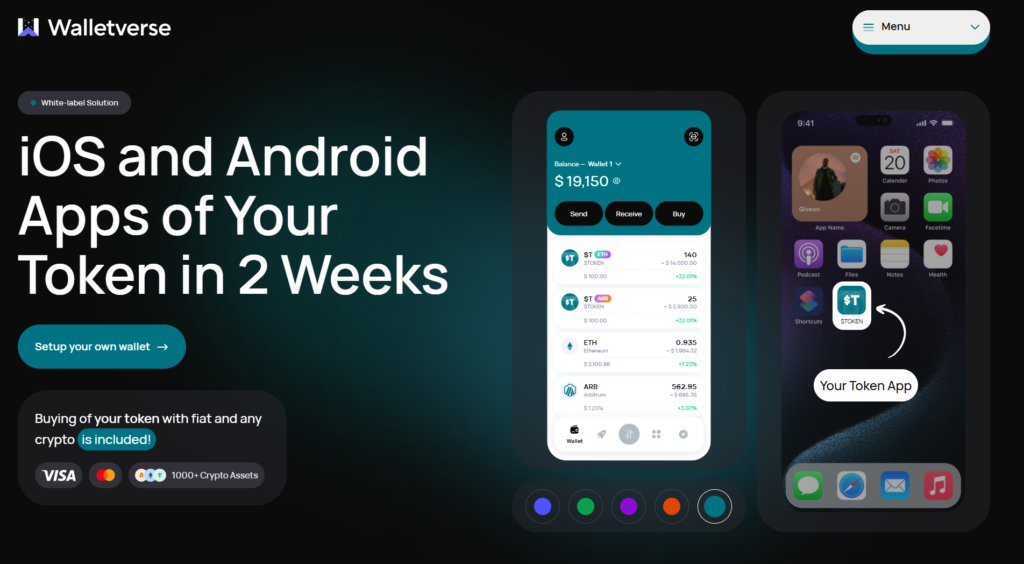
Walletverse is a non-custodial, mobile-first white label crypto wallet designed for enterprise-grade compliance and security.
With AML functionality built in, Walletverse is ready to integrate with decentralized identity frameworks and supports rapid deployment of KYC workflows.
Key security features include:
- CryptoAES encryption, ECDSA digital signatures
- OWASP SAST compliance
- BIP32, BIP39, BIP44 protocol support
- Secure storage of entropy with 128-bit and 256-bit seed phrase generation
- Compatibility with Visa, Mastercard, Apple Pay, and Google Pay
Walletverse enables businesses to launch a compliant, secure, and fully branded crypto wallet in as little as two weeks—perfect for enterprises operating in regulated industries.
The future of crypto isn’t just decentralized—it’s also compliant. By integrating blockchain-based KYC into white label wallets, businesses can meet the demands of regulators while protecting user privacy and maintaining Web3 values.
As on-chain identity infrastructure continues to evolve, white label crypto wallets will play a central role in making compliant and user-controlled finance the global standard.