

White labeling is a practical strategy for companies that want to expand their digital asset products without building every part of the technology from scratch. In the crypto wallet sector, this approach allows fintech companies, Web3 startups, payment platforms, and digital businesses to launch branded wallet products using existing infrastructure.
Instead of investing years into blockchain integrations, wallet architecture, mobile development, transaction logic, security layers, and compliance-related tools, a business can use a ready-made wallet foundation and adapt it to its own brand and users.
The market context supports this demand. According to Research and Markets (2026), the crypto wallet market is valued at USD 25 billion in 2026 and is projected to reach USD 69.02 billion by 2030, growing at a CAGR of 28.9%. According to Grand View Research (2026), the global crypto wallet market is expected to grow from USD 15.54 billion in 2025 to USD 100.77 billion by 2033, with a CAGR of 26.6% from 2026 to 2033.
This article was prepared by ilink, a software and blockchain technology developer with 14 years of experience in the fintech industry.
What Is White Label as a Strategic Business Model?
White labeling is a business model where a product made by one company is rebranded and sold by another company as its own. In crypto wallet development, this usually means that the technology provider creates the wallet infrastructure, while the client company launches it under its own brand.
A white label crypto wallet can include mobile apps, blockchain network support, payment integrations, private key protection, seed phrase generation, dApp access, DeFi functionality, NFT support, AML tools, and administrative features. The business using the product can then focus on branding, marketing, customer support, compliance preparation, and user acquisition.
This model helps companies reduce technical complexity and enter the market faster. It is especially useful in crypto and fintech because wallet infrastructure requires security expertise, blockchain knowledge, continuous updates, and careful attention to regulatory expectations.
1. Walletverse Cryptocurrency Wallet
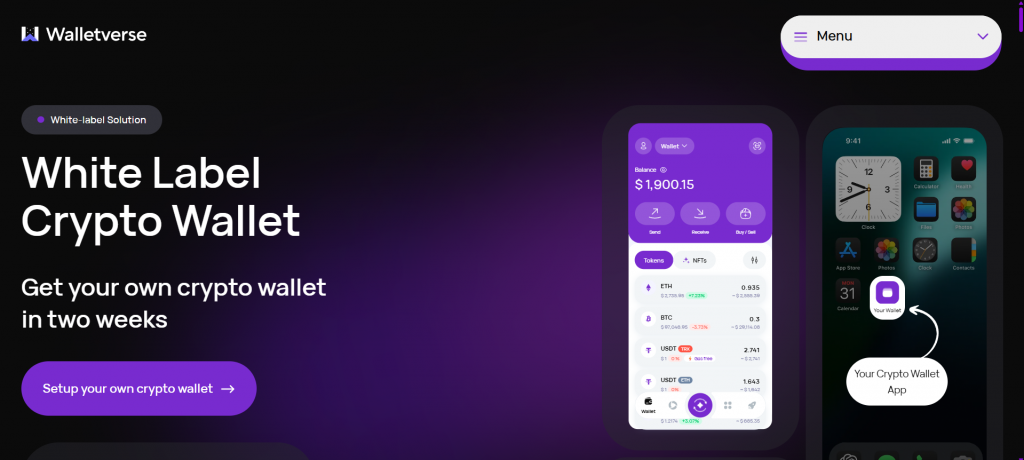
A standout example in fintech is Walletverse, a non-custodial mobile cryptocurrency wallet that offers businesses a ready-made white label foundation. It supports over 1000 cryptocurrencies and includes security features such as biometric protection, password codes, and compliance with CryptoAES, ECDSA, OWASP SAST, and BIP standards.
Walletverse allows businesses to launch their own branded wallet within two weeks. It also supports Visa, MasterCard, Google Pay, and Apple Pay integrations, along with AML functionality that helps companies address compliance-related requirements.
This makes Walletverse a practical example of how a white label crypto wallet app can support faster entry into the cryptocurrency market while keeping key wallet features, security, and user experience already considered.
Key features include:
- Payment integrations: Visa, MasterCard, Google Pay, and Apple Pay support;
- Security tools: Biometric protection, password codes, CryptoAES, ECDSA, and OWASP SAST;
- Wallet standards: Support for BIP32, BIP39, and BIP44;
- Asset support: Access to over 1000 cryptocurrencies;
- Web3 functionality: dApps, DeFi, and NFT support;
- AML capabilities: Tools that help businesses manage regulatory and transaction-related risks.
2. White Label Crypto Payment Infrastructure
Another successful white label product category in the wallet ecosystem is payment infrastructure. A white label crypto payment gateway allows businesses to accept, process, and manage cryptocurrency payments under their own brand without building the entire transaction system independently.
This type of product is especially relevant for fintech companies, eCommerce platforms, marketplaces, and digital services that want to add crypto payment functionality. It can support deposits, withdrawals, payment routing, transaction monitoring, wallet management, and fiat-to-crypto or crypto-to-fiat flows depending on the product architecture.
For companies, the main value is practical. They can add crypto payment capabilities faster, while relying on infrastructure that has already been designed for transaction processing, security, and scalability.
3. White Label Digital Wallet Products
A white label digital wallet solution can support broader fintech use cases beyond crypto storage. It may include user accounts, digital asset balances, transfers, payment cards, transaction history, identity verification, and integrations with external financial services.
In the crypto sector, this type of product is often used when a business wants to combine traditional fintech functionality with Web3 access. For example, a wallet may allow users to buy crypto with a card, store tokens, send assets, connect to dApps, or manage NFTs in one branded mobile app.
This model works well for companies that need a wallet experience but do not want to build every financial and blockchain integration from the ground up.
4. White Label Blockchain Solutions for Web3 Access
White label products can also cover broader Web3 infrastructure. White label blockchain solutions may include wallet connectivity, token support, smart contract interaction, dApp access, NFT tools, DeFi integrations, and transaction approval flows.
This is important because crypto wallets are no longer used only for storing assets. Ethereum.org describes wallets as tools that allow users to connect to applications through their blockchain accounts, which reflects the wallet’s role as an access point to Web3 services.
For businesses, this creates an opportunity to launch wallet-based products that connect users to decentralized services while keeping the experience inside their own branded environment.
5. White Label Wallet Solutions for Mobile Products
A white label wallet solution is often most effective when it is designed for mobile use. Many users expect crypto wallets to work like modern fintech apps: fast onboarding, clear navigation, biometric access, payment options, and simple transaction management.
Mobile wallet products can be especially useful for businesses that already have a customer base and want to add digital asset functionality. Instead of asking users to move to a third-party wallet, the company can offer wallet access inside its own branded ecosystem.
This helps improve product consistency and gives the business more control over the user journey.
6. White Label Crypto Wallet Development for Faster Market Entry
White label crypto wallet development is suitable for businesses that want to launch quickly but still need a reliable technical foundation. Instead of creating the whole product from zero, the company can customize an existing wallet infrastructure and focus on market validation.
A simple launch process may look like this:
Step 1. Choose the wallet foundation based on supported assets, security features, custody model, payment options, and compliance needs.
Step 2. Customize the interface, branding, onboarding flow, integrations, and user-facing functionality.
Step 3. Launch the wallet, collect user feedback, and expand features based on real demand.
This approach reduces development risk and helps businesses test whether the product fits their audience before investing in deeper custom development.
Why These White Label Examples Matter for Crypto Businesses
These examples show how white labeling can support different parts of the crypto wallet ecosystem. A business can launch a wallet app, add crypto payments, integrate Web3 functionality, or build a broader digital wallet product without developing every technical layer internally.
The main business value comes from speed, cost control, and reduced infrastructure complexity. At the same time, companies still need to evaluate the provider carefully because crypto wallet products depend on security, scalability, compliance readiness, and long-term support.
Important factors to review include:
- Security architecture and private key protection;
- Supported blockchains and crypto assets;
- Payment and fiat integration options;
- AML and transaction monitoring capabilities;
- Mobile app quality and user experience;
- Customization limits and branding flexibility;
- Provider support, maintenance, and update policies.
Practical Value of White Label Wallet Products
White label products in crypto wallet infrastructure help companies move from idea to launch faster. They allow businesses to focus on positioning, users, partnerships, and growth while relying on a technical foundation that already includes core wallet functionality.
This does not remove the need for due diligence. A company should still check how the wallet handles security, compliance, scalability, integrations, and user data before launch.
Walletverse by ilink is a practical example of how white label crypto wallet development services can help businesses launch a branded wallet product with crypto payments, Web3 features, mobile access, and security functionality already built into the foundation.
Planning to launch a branded crypto wallet? A white label model can help you enter the market faster, test demand, and build a scalable wallet product without starting from zero.