

Billions of people around the world still lack access to basic financial services. In regions across Africa, Southeast Asia, and Latin America, traditional banking infrastructure is either insufficient or completely absent. This financial exclusion limits economic opportunity, stifles growth, and forces people to rely on cash-based systems prone to fraud and inefficiency.
Enter white label crypto wallets—customizable, decentralized wallet solutions that can be rapidly deployed to bring secure, borderless, and low-cost financial tools directly into people’s hands. Without relying on traditional banks, these wallets are helping to reshape the future of financial access in emerging markets.
The Financial Inclusion Gap in Emerging Markets
According to the World Bank, over 1.4 billion adults remain unbanked globally. In many emerging economies, access to banks is hindered by:
- Lack of documentation (ID or proof of address)
- Poor infrastructure (few branches, unreliable electricity or internet)
- Low trust in institutions
- High fees and minimum balance requirements
However, there’s a silver lining: mobile phone penetration is surging, even in remote areas. This provides a powerful foundation for digital financial tools—especially blockchain-based solutions that require no physical branches or intermediaries.
Why Crypto Wallets Are Key to Financial Empowerment
Cryptocurrencies offer several advantages over traditional finance in underserved regions:
- Borderless access. Send or receive money globally with no bank involvement.
- Inflation protection. Use of stablecoins and Bitcoin in countries with unstable fiat currencies (e.g., Argentina, Nigeria).
- Decentralized finance (DeFi). Access to savings, loans, and yield farming without credit scores or bank accounts.
- Always available. All you need is a smartphone or basic internet access.
A crypto wallet becomes a personal financial hub, enabling users to store value, pay, receive, and grow assets—all without a bank.
How White Label Crypto Wallets Bridge the Gap
White label crypto wallets are pre-built wallet infrastructures that can be customized, branded, and launched by organizations looking to serve new or niche markets. For emerging economies, these wallets offer:
- Local language support and familiar design.
- Lightweight mobile performance for low-bandwidth networks.
- Offline functionality to support peer-to-peer transactions even without constant internet access.
- Integrated fiat on/off-ramps, allowing users to convert between local currency and crypto.
With quick deployment and low development costs, white label solutions are ideal for NGOs, fintech startups, and regional governments.
Key Features for Emerging Market Wallet Solutions
To meet the needs of unbanked and underbanked populations, white label wallets should include:
- Multi-currency and stablecoin support to minimize volatility.
- Mobile-first, data-light design optimized for older devices and 3G networks.
- QR code and NFC-based payments for cashless transactions without bank cards.
- Offline mode for sending/receiving when temporarily disconnected.
- Biometric login options to replace PINs or passwords, supporting users with low literacy.
- Minimalist and intuitive UX for first-time users unfamiliar with crypto concepts.
These features make wallets more accessible to everyday users in challenging environments.
Use Cases Transforming Lives
White label wallets are already powering impactful change in emerging markets:
- Peer-to-peer (P2P) payments. Friends, family, or merchants can send and receive funds instantly without intermediaries.
- Remittances. Migrant workers send funds home without high remittance fees.
- DeFi-powered savings. Users earn interest on stablecoins without needing a bank account.
- Community currency initiatives. Local organizations create tokens to incentivize economic activity or distribute benefits.
- NGO aid distribution. Humanitarian agencies deliver tokens directly to recipients, ensuring transparent, traceable use.
Each use case helps users reclaim economic agency and participate in the digital economy.
Benefits for Governments, NGOs, and Local Businesses
Beyond individual users, entire communities benefit from decentralized wallet solutions:
- NGOs can distribute financial aid transparently and securely.
- Governments can issue digital subsidies or community grants without needing expensive banking infrastructure.
- Small businesses and informal merchants can accept payments, store value, and offer rewards—all through a mobile app.
By bypassing traditional financial gatekeepers, these stakeholders can scale their impact quickly and efficiently.
Overcoming Challenges
Deploying wallet solutions in emerging markets is not without hurdles:
- User education. Many first-time users need help understanding seed phrases, wallet recovery, and transaction fees.
- Volatility management. Stablecoin integration is critical to ensure asset stability in high-inflation economies.
- Regulatory compliance. Projects must navigate KYC/AML requirements, especially in identity-scarce regions.
- Security and trust. Building user confidence requires transparent communication, open-source code, and secure key management.
The good news: white label solutions are increasingly addressing these challenges with pre-built features and best practices.
The Future of Decentralized Finance in Developing Economies
As blockchain infrastructure continues to evolve, white label wallets will play an even bigger role in developing countries:
- Community-owned DAOs could manage local economies through tokenized governance.
- Decentralized identity (DID) integration will unlock access to credit and services without formal documentation.
- Cross-border wallet networks will enable seamless regional trade and remittances.
- AI-driven financial insights could offer personalized financial guidance to first-time users.
Wallets are no longer just storage tools—they’re a gateway to full economic participation.
Walletverse for Emerging Market Solutions
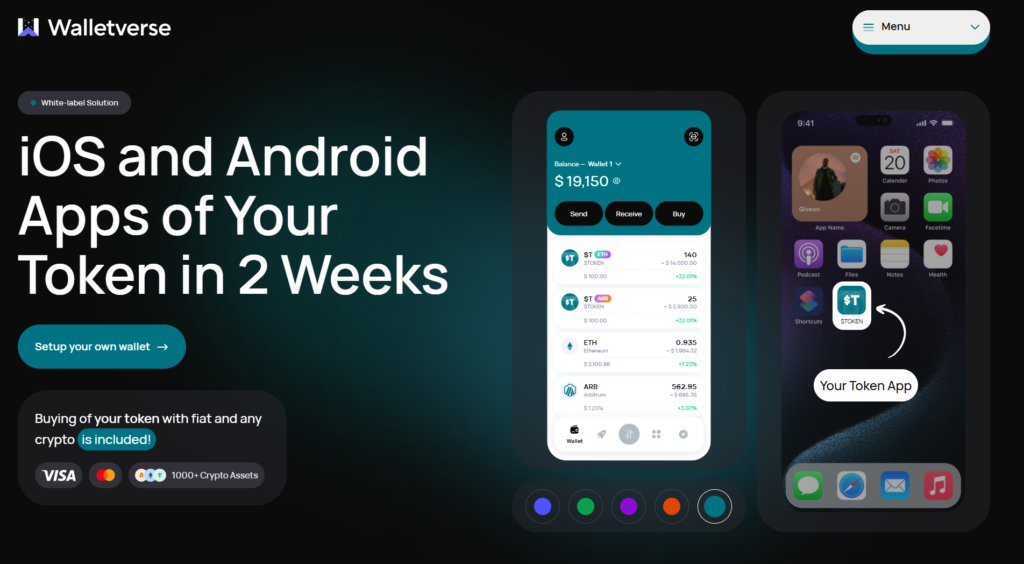
Walletverse is a secure, mobile-ready white label crypto wallet designed specifically for accessibility and impact in low-infrastructure regions.
Its features include:
- Support for over 1000 cryptocurrencies, including stablecoins.
- Offline transaction capabilities for areas with limited connectivity.
- Biometric login, multi-language UI, and intuitive design.
- AML-compliant architecture, CryptoAES, ECDSA, and BIP32/BIP39/BIP44 standards.
- Launch-ready in just two weeks—ideal for NGOs, governments, and fintech projects seeking to empower users without access to banks.
In emerging markets, financial inclusion is more than a buzzword—it’s a lifeline. White label crypto wallets provide a fast, affordable, and customizable way to empower unbanked populations with secure, decentralized financial tools. By bypassing traditional banks and embracing mobile-first, blockchain-powered solutions, communities can unlock a new era of financial sovereignty.
The future of inclusive finance is here—and it’s borderless, bankless, and blockchain-powered.