

As digital assets continue their march toward mainstream adoption, traditional financial institutions (TradFi) face a critical decision: adapt or fall behind. With growing demand from clients for crypto exposure, many banks, wealth managers, and fintechs are exploring how to offer blockchain-based services in a compliant, secure, and user-friendly way.
Enter white label crypto wallets—ready-to-launch, customizable wallet solutions that provide institutions with a branded interface to safely onboard users into the crypto economy. For legacy finance players looking to tap into DeFi, stablecoins, and tokenized assets without building infrastructure from scratch, these wallets offer a fast and strategic gateway.
The Institutional Shift Toward Crypto and Web3
The last few years have seen a dramatic shift in the financial landscape. Retail and institutional investors alike are demanding access to digital assets—from Bitcoin and Ethereum to stablecoins, NFTs, and tokenized securities. Global financial firms are responding:
- Goldman Sachs and JPMorgan exploring tokenized assets.
- BlackRock launching crypto investment products.
- Mastercard and Visa integrating stablecoin rails.
But integrating crypto into traditional systems is complex, often requiring new infrastructure, regulatory clearance, and UX overhauls. That’s why white label wallets—pre-built and fully brandable—have become vital onboarding tools.
The Role of White Label Wallets in Bridging TradFi and DeFi
A white label crypto wallet is a turnkey solution that allows financial institutions to offer secure, user-facing digital asset functionality under their own brand. Rather than building from the ground up, institutions can launch wallets that support token storage, transfers, staking, and even DeFi access—tailored to their customer base and compliance requirements.
These wallets serve as a critical bridge between traditional financial interfaces and the decentralized world. For clients, they maintain trust by aligning with an institution’s brand. For firms, they reduce development time and ensure rapid market readiness.
Key Features for Financial Institutions Using White Label Wallets
To serve institutional use cases, a white label wallet must offer:
- Multi-asset support — Bitcoin, Ethereum, stablecoins, and tokenized securities;
- Compliance integrations — KYC/AML flows, transaction screening, and audit trails;
- Custody options — support for non-custodial, custodial, or hybrid models;
- User role segmentation — admin dashboards for advisors, user accounts for clients;
- Security features — biometric login, passcode protection, hardware wallet compatibility;
- Regulatory flexibility — modular architecture to meet local and international requirements.
With these features, firms can deliver intuitive, secure wallet experiences even to users new to digital assets.
Benefits of White Label Wallets for Financial Institutions
White label wallets provide institutions with a competitive edge through:
- Faster time to market.
No need to develop crypto infrastructure from scratch—deploy in weeks, not months. - Brand trust & continuity.
Deliver a fully branded experience aligned with existing digital platforms. - Compliance & control.
Pre-built modules for regulatory adherence and secure data management. - Product expansion.
Offer clients access to crypto portfolios, stablecoin savings, tokenized investments, or DeFi products. - Broader appeal.
Attract younger, digitally-native clients while expanding service offerings for existing customers.
Use Cases Across the Financial Sector
Retail Banks.
Offer customers crypto savings accounts, stablecoin transfers, or loyalty rewards in tokens.
Private Wealth Managers.
Provide tokenized asset access and on-chain portfolio diversification via secure wallets.
Advisory Platforms.
Enable advisors to view, manage, and report on client crypto holdings in a compliant environment.
Corporate Banks.
Streamline cross-border payments using stablecoins and programmable smart contract-based treasury functions.
Neobanks and Fintechs.
Launch crypto-first banking experiences under their own brand with institutional-grade wallet support.
Walletverse: A White Label Wallet Platform Built for Finance
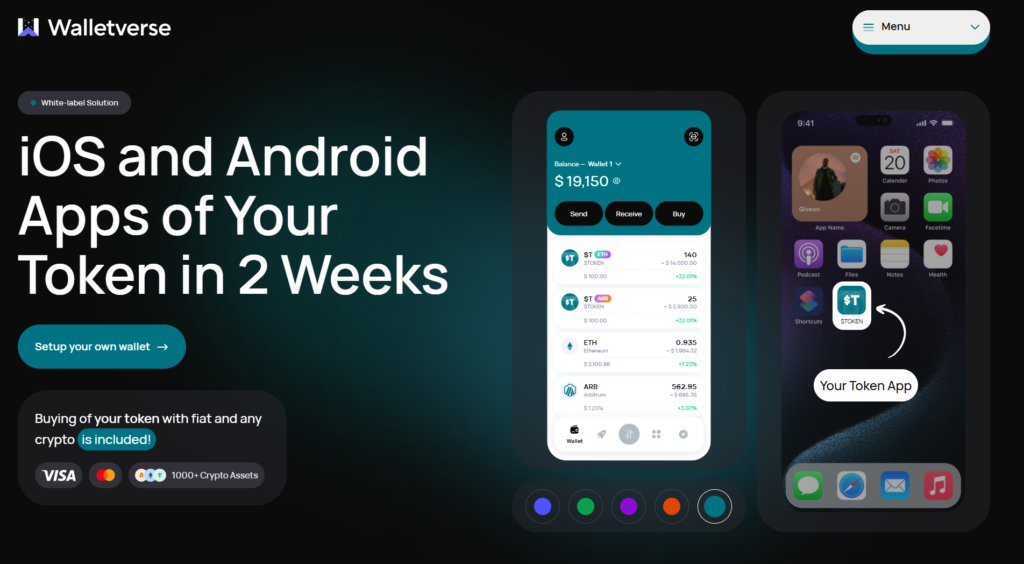
For traditional financial institutions seeking to enter the crypto market with confidence, Walletverse offers a customizable, compliant, and scalable wallet solution.
Walletverse features include:
- Multi-chain and multi-asset support;
- KYC/AML integration and audit-ready infrastructure;
- Apple Pay, Google Pay, and fiat-to-crypto capabilities;
- Multi-role permissions for admins, advisors, and end users;
- Biometric authentication and private key management;
- Custom branding, UI control, and seamless user onboarding.
With Walletverse, banks and financial institutions can deploy wallet apps that reflect their identity—while offering users a secure and intuitive entry into the world of digital assets.
Implementation Strategy: From Pilot to Production
Financial institutions can deploy white label wallets using a phased approach:
- Define your crypto use case: custody, payments, tokenization, or yield-bearing products;
- Select token standards and supported chains;
- Design the user journey and branding for a seamless experience;
- Integrate KYC, AML, and compliance tools;
- Conduct pilot testing with internal stakeholders or select clients;
- Scale with marketing, education, and support infrastructure.
By working with an experienced wallet provider, institutions can ensure security, scalability, and regulatory alignment at every stage.
The line between traditional and decentralized finance is blurring—and white label crypto wallets are the bridge. For financial institutions looking to offer digital asset services, these wallets deliver the infrastructure, branding flexibility, and regulatory readiness needed to compete in the new era of finance.
Whether you’re enabling crypto savings, launching tokenized investment products, or preparing for stablecoin-based payments, a white label wallet offers a faster, safer, and smarter path forward.