

In today’s rapidly digitizing world, identity is becoming the key to accessing everything—finance, healthcare, education, employment, and more. Yet, our current systems for managing digital identity are fragmented, insecure, and largely controlled by centralized institutions. Web3 introduces a new paradigm: decentralized identity, where individuals own and control their personal data. White label crypto wallets are uniquely positioned to become the digital identity hubs of this new era, enabling users to securely manage credentials on the blockchain.
The Problem with Traditional Digital Identity
The current digital identity landscape relies on siloed databases maintained by governments, banks, corporations, and social platforms. These systems are prone to:
- Data breaches that expose sensitive personal information.
- Identity theft resulting from poorly protected centralized storage.
- User lock-in where access to services is dependent on third-party platforms.
This model not only compromises security and privacy but also limits interoperability and user control—two values that are foundational to Web3.
What Is Blockchain-Based Digital Identity?
Blockchain-based digital identity, often referred to as decentralized identity (DID) or self-sovereign identity (SSI), allows individuals to own and manage their personal data without relying on centralized authorities.
Key components include:
- Decentralized identifiers (DIDs). Unique blockchain-based IDs tied to a user’s wallet.
- Verifiable credentials (VCs). Digitally signed proofs of facts (like KYC status, degrees, licenses) that can be stored and shared securely.
- Blockchain registries. Tamper-proof systems for verifying the authenticity of credentials without exposing sensitive information.
This system ensures privacy, security, and interoperability—allowing credentials to be shared across services while remaining under user control.
The Role of White Label Wallets in Identity Management
Modern crypto wallets are evolving beyond key storage and transaction tools. When enhanced with identity features, white label wallets become secure, portable platforms for managing digital credentials.
With an identity-enabled white label wallet, users can:
- Store digital IDs, licenses, diplomas, and other credentials.
- Authenticate access to Web3 platforms without passwords.
- Verify their identity without revealing unnecessary personal details.
These capabilities turn wallets into identity command centers that integrate directly into the decentralized web.
Benefits of Managing Identity Through White Label Crypto Wallets
Implementing decentralized identity through white label wallets brings several strategic advantages:
- User ownership. Individuals decide when and how to share their identity data.
- Enhanced privacy. Technologies like zero-knowledge proofs allow users to prove facts (e.g., age or citizenship) without revealing documents.
- Interoperability. One identity works across DeFi platforms, marketplaces, healthcare portals, and more.
- Portability. Identities are no longer tied to a single provider and can be accessed from anywhere in the world.
This level of freedom redefines how users interact with digital ecosystems.
Key Features for Identity-Enabled White Label Wallets
To serve as effective identity hubs, white label wallets should offer:
- DID and VC support. Compliance with W3C standards ensures global interoperability.
- Encrypted credential storage. Either locally or on-chain/IPFS with user-controlled keys.
- Biometric authentication. For fast and secure access to identity data.
- Issuer integration. Ability to receive credentials from KYC providers, schools, governments, etc.
- Consent-based sharing. Clear permission workflows for users to manage what they share and with whom.
These features transform a wallet into a trusted digital identity vault.
Use Cases Across Industries
Decentralized identity has applications far beyond crypto:
- Finance. KYC and AML checks are stored as verifiable credentials, reusable across platforms.
- Healthcare. Store and present health records, insurance documents, and prescriptions.
- Education. Manage diplomas, training certificates, and course completions.
- Employment. Verify work history, freelance credentials, or remote team access rights.
- E-Government. Digital citizenship, e-voting, and residency verification.
Each of these use cases benefits from the security, privacy, and portability of a blockchain-enabled identity wallet.
Security and Privacy Considerations
Protecting identity credentials is critical. Key best practices include:
- Secure private key storage. Using hardware-backed or biometric-protected encryption.
- Data minimization. Sharing only what is necessary for a given context.
- Revocation mechanisms. Ability to update or invalidate credentials in real time.
- Compliance readiness. Aligning with regulations like GDPR, CCPA, and emerging digital identity laws.
By embedding these into white label wallets, providers can deliver trust and peace of mind to users and regulators alike.
Future of Digital Identity in Web3
Looking ahead, digital identity wallets will evolve far beyond simple credential storage:
- Universal Web3 login tools. Replace email/password with wallet-based authentication.
- On-chain reputation systems. Build credit scores and trust scores through verified interactions.
- Metaverse integration. Use identity credentials to control avatars, digital assets, and virtual presence.
- Decentralized access control. Open doors, grant permissions, or enter communities based on on-chain identity.
White label wallet providers who embrace identity now will be positioned to lead this transformation.
Walletverse: A Digital Identity-Ready White Label Wallet
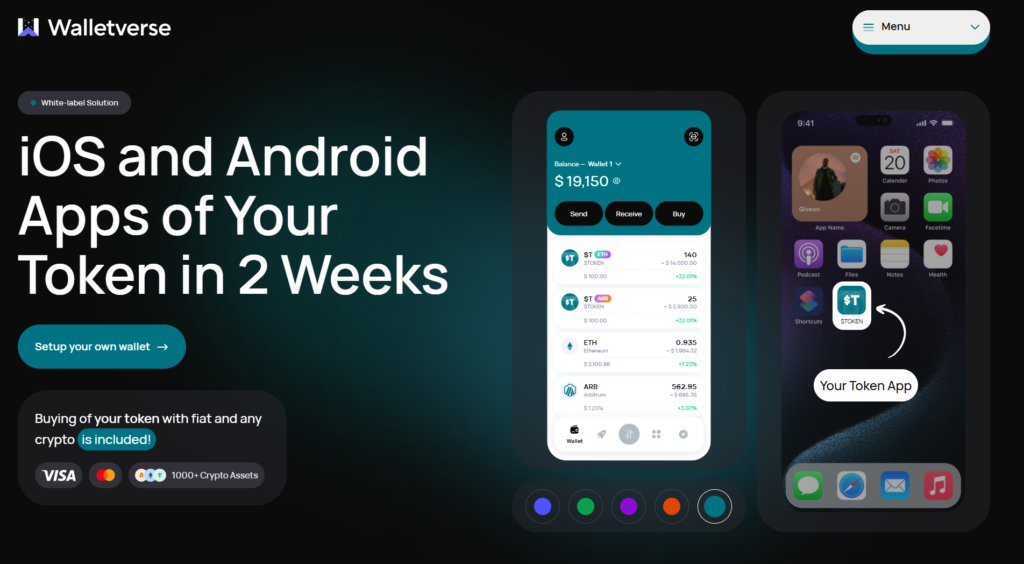
Walletverse is a robust, non-custodial white label crypto wallet solution engineered for the future of decentralized identity.
It offers support for decentralized identifiers (DIDs), verifiable credentials, and encrypted storage, allowing users to securely manage identity credentials alongside digital assets.
Security features include:
- CryptoAES and ECDSA encryption
- Biometric authentication and passcode protection
- BIP32/BIP39/BIP44 support for key generation
- Compliance with OWASP SAST and KYC/AML integration
Walletverse supports 1000+ cryptocurrencies, DeFi, dApps, and NFTs. Businesses can launch a fully branded, identity-enabled wallet in just two weeks, empowering their users with both financial tools and personal data sovereignty.
As identity becomes central to trust and access in the digital world, crypto wallets are perfectly positioned to take the lead. By integrating decentralized identity features, white label crypto wallets can serve as powerful, privacy-respecting tools for individuals and businesses alike.
The shift from centralized ID systems to user-controlled digital credentials is underway—and wallets are the new gateway. For companies seeking to future-proof their platforms, adopting identity-ready white label wallets isn’t just smart—it’s essential.