

The demand for cryptocurrency wallets is growing as digital assets become more common in fintech, banking, e-commerce, trading, and decentralized finance. For businesses, the wallet is often the main user-facing product in the digital asset ecosystem because it allows customers to store crypto, send and receive transactions, access DeFi tools, manage NFTs, and interact with blockchain-based services from a mobile device.
Developing a crypto wallet for iOS from scratch can be costly, time-intensive, and technically complex. A white label iOS crypto wallet gives businesses a ready-made, customizable solution that can be launched under their own brand while reducing the need for full in-house development.
According to Research and Markets (2026), the crypto wallet market is valued at USD 25 billion in 2026 and is projected to reach USD 69.02 billion by 2030, growing at a CAGR of 28.9%. The report connects this growth with rising demand for interoperable wallet solutions, Web3 applications, decentralized services, and stronger biometric or hardware-based security.
This article was prepared by ilink, a software and blockchain technology developer with 14 years of experience in the fintech industry.
What Is a White Label iOS Crypto Wallet?
A white label crypto wallet for iOS is a pre-developed and customizable mobile application designed for Apple devices. It allows businesses to rebrand, modify, and deploy a secure crypto wallet under their own name without building the full product from scratch.
Unlike custom crypto wallet development, which can take months or even years, a white label solution provides a faster route to market with essential wallet functionality already included. This usually covers sending, receiving, storing, and managing digital assets, along with security features, compliance tools, and user experience elements optimized for mobile use.
A strong white label wallet solution can help companies offer digital asset services while still adapting the product to their brand, target audience, business model, and operational requirements.
How a White Label iOS Crypto Wallet Works
A white label iOS crypto wallet follows a structured development and deployment process. The technology provider builds and maintains the wallet infrastructure, while the business customizes and launches the product under its own brand.
The process usually works like this:
- Core wallet development. A technology provider develops a secure and feature-rich iOS crypto wallet with blockchain integrations, transaction logic, and security features;
- Licensing and customization. Businesses license the software and customize branding, user interface elements, and selected functionality;
- App Store publishing. The app is published on the App Store under the business’s name, making it available to iOS users;
- Ongoing provider support. The provider handles security updates, compliance support, technical maintenance, and product improvements to ensure smooth operation.
This model allows businesses to focus on market entry, customer acquisition, and product growth while relying on an existing technical foundation.
Why Businesses Choose a White Label Crypto Wallet for iOS
Businesses choose white label iOS wallets because they provide a faster and more cost-effective way to enter the digital asset market. The model is especially useful for companies that need mobile wallet functionality, strong security, compliance readiness, and a branded user experience.
Key reasons include:
- Rapid market entry. Developing an iOS crypto wallet from the ground up involves blockchain development, security testing, mobile QA, and compliance preparation. A white label wallet can help businesses launch their own branded solution within weeks instead of months or years;
- Cost-effective solution. Building a secure crypto wallet requires blockchain developers, iOS engineers, UI/UX designers, security experts, and compliance specialists. A white label solution helps reduce development and maintenance costs;
- Brand customization and user experience. Businesses can customize logos, colors, interface elements, onboarding flows, and selected features to create a seamless brand experience for users;
- High-level security and compliance. Cryptocurrency transactions require strong protection. White label wallets can include encryption, biometric authentication such as Face ID, multi-signature transactions, and compliance features such as KYC and AML tools;
- Multi-currency and blockchain support. Most white label wallets support Bitcoin, Ethereum, stablecoins, and altcoins, along with blockchain integrations for networks such as Ethereum, BNB Chain, Solana, and others;
- Seamless App Store deployment. Apple has specific requirements for crypto-related applications, so choosing a provider with iOS experience can help reduce approval risks and support a smoother launch process.
For businesses planning a white label mobile wallet, these benefits can reduce technical barriers while still allowing the product to fit the company’s brand and user needs.
Industries That Benefit from White Label iOS Crypto Wallets
White label iOS crypto wallets can support different industries where mobile access, digital assets, payments, Web3 services, or tokenized products are part of the user experience. The strongest use cases are usually connected to fintech, banking, trading, DeFi, e-commerce, NFTs, and gaming.
Industries that can benefit include:
- Crypto exchanges and trading platforms. Exchanges can offer users a secure, mobile-friendly crypto wallet for storing and managing assets, improving the overall trading experience;
- Fintech and banking. Neobanks and financial institutions can integrate crypto wallet functionality into digital banking applications, supporting smoother interaction between crypto and fiat currencies;
- E-commerce and retail. Online merchants can enable crypto payments through white label wallets, allowing users to pay with digital assets directly from mobile devices;
- DeFi and NFT marketplaces. Decentralized finance platforms and NFT marketplaces can use branded wallets to support staking, lending, yield farming, NFT storage, and decentralized application access;
- Gaming and virtual economies. Blockchain-based gaming platforms and metaverse projects can integrate in-game crypto wallets, allowing players to store, trade, and manage digital assets more easily.
For companies building white label fintech solutions, an iOS crypto wallet can become a practical way to connect mobile banking, digital payments, Web3 access, and crypto asset management in one branded product.
Walletverse as a White Label iOS Crypto Wallet Solution
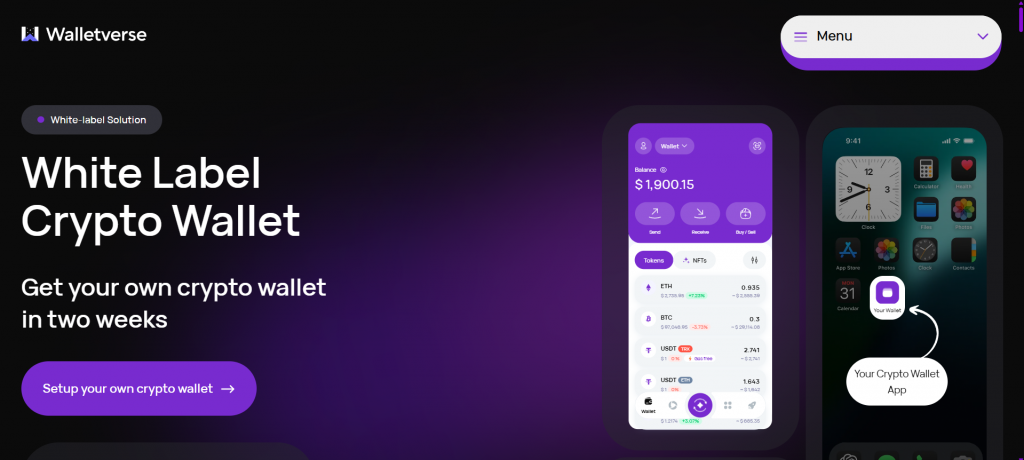
One of the advanced white label solutions for iOS crypto wallets is Walletverse, a non-custodial cryptocurrency wallet designed for businesses that want to enter the digital asset market quickly and securely.
Walletverse allows businesses to launch a branded mobile wallet with support for 1,000+ cryptocurrencies, including Bitcoin, Ethereum, DeFi tokens, and other digital assets. It also supports payment integrations such as Visa, MasterCard, Apple Pay, and Google Pay, helping users buy, sell, and spend crypto through a mobile-first experience.
The product is designed for fintech startups, crypto exchanges, financial service providers, Web3 platforms, and businesses that need a scalable wallet foundation. Walletverse combines mobile usability, security-focused infrastructure, DeFi and NFT functionality, and regulatory tools in one customizable product.
Why Choose Walletverse?
Walletverse offers a set of features that can help businesses launch a branded iOS crypto wallet faster while maintaining security, usability, and compliance readiness.
Key features include:
- Support for 1,000+ cryptocurrencies. Walletverse allows businesses to offer users access to Bitcoin, Ethereum, DeFi tokens, stablecoins, and other digital assets;
- Seamless payment integrations. Users can buy, sell, and spend crypto through Visa, MasterCard, Apple Pay, and Google Pay integrations;
- Advanced security features. Walletverse uses CryptoAES encryption, ECDSA authentication, and OWASP SAST security measures to help protect user data and funds;
- DeFi and NFT support. The wallet enables staking, NFT storage, and decentralized application interactions directly from the mobile wallet;
- Fast deployment. Businesses can launch a fully branded crypto wallet in as little as two weeks, reducing time to market;
- Regulatory compliance. Built-in AML and KYC tools help businesses support safer wallet operations and align with financial regulations.
Walletverse offers businesses a scalable and security-focused wallet solution that can support iOS users while reducing the complexity of full custom development.
Key Features of a White Label iOS Crypto Wallet
A high-quality iOS crypto wallet should combine mobile usability, strong security, blockchain compatibility, and reliable transaction tools. These features affect both user trust and long-term product performance.
A strong white label cryptocurrency wallet should include:
- User-friendly iOS interface. The wallet should be optimized for Apple devices, with clear navigation and simple access to key wallet actions;
- Multi-chain support. The wallet should support different blockchain networks so users can manage diverse digital assets;
- Face ID and Touch ID authentication. Biometric access helps improve security and convenience for mobile users;
- QR code payments. QR functionality makes transactions faster and easier to complete;
- Fiat on-ramp and off-ramp services. Users should be able to buy crypto or convert assets through integrated payment services;
- Real-time transaction history and portfolio management. Users need clear visibility into balances, transaction status, and asset performance;
- Push notifications. Alerts can inform users about price changes, transaction confirmations, and wallet activity;
- API integrations. APIs help connect the wallet with exchanges, payment systems, KYC providers, analytics tools, and other third-party services.
These features help businesses create a mobile wallet experience that is secure, practical, and easier to scale.
How to Choose the Right White Label Crypto Wallet Provider
Choosing the right provider is one of the most important steps in launching a branded iOS crypto wallet. The provider affects security, App Store readiness, compliance, scalability, user experience, and long-term maintenance.
Key factors to evaluate include:
- Customization and branding options. The provider should offer branding flexibility, allowing modifications to UI elements, logos, colors, user flows, and feature sets;
- Security and compliance standards. Businesses should look for strong security features such as multi-signature transactions, biometric authentication, encrypted private key storage, and compliance tools;
- Scalability and future-proofing. The wallet should support future expansion, including new cryptocurrencies, blockchain integrations, DeFi functionality, and additional payment features;
- App Store approval support. The provider should understand App Store guidelines for crypto apps and help reduce approval risks;
- Ongoing maintenance. A reliable provider should offer updates, security patches, technical support, and product improvements after launch;
- Integration capabilities. The wallet should connect with payment providers, DeFi services, analytics platforms, KYC tools, and other business systems.
For businesses planning white label crypto wallet development, provider selection should be based not only on launch speed but also on long-term reliability, security, and product flexibility.
How White Label iOS Wallets Support Digital Finance Growth
A white label iOS crypto wallet is a cost-effective, secure, and scalable option for businesses that want to enter the digital finance space. Instead of navigating the full complexity of blockchain development, iOS engineering, App Store approval, and compliance preparation, companies can use a pre-built wallet foundation and adapt it to their needs.
For businesses planning crypto wallet development, the white label model can shorten the path from product idea to market launch. It also allows companies to focus more on users, customer support, payments, compliance strategy, partnerships, and product growth.
Solutions like Walletverse make it possible to launch a feature-rich and security-focused mobile wallet in a shorter timeline, helping businesses streamline crypto transactions, integrate DeFi functionality, and improve digital asset management.
If your business is planning to launch a branded iOS crypto wallet, start by defining the required assets, security expectations, compliance needs, payment integrations, user flows, and long-term feature roadmap. Walletverse by ilink can serve as a practical example of how white label wallet infrastructure can support faster market entry and a more structured product launch.