

In today’s digital-first world, mobile applications have become a critical tool for businesses that want to connect with customers through fast, secure, and convenient digital services. For companies entering fintech, crypto, or Web3, an Android wallet app can become the main user-facing product for storing assets, sending transactions, accessing payment tools, and interacting with blockchain-based services.
However, building an Android crypto wallet from scratch requires significant investment in development, testing, security, compliance, and long-term maintenance. Many businesses, especially startups and enterprises looking for faster market entry, choose a white label Android app as a ready-made and customizable alternative that can be branded and adapted to specific business needs.
According to Research and Markets (2026), the crypto wallet market is valued at USD 25 billion in 2026 and is projected to reach USD 69.02 billion by 2030, growing at a CAGR of 28.9%. The report connects this growth with rising demand for interoperable wallet solutions, Web3 applications, decentralized services, and stronger biometric or hardware-based security.
This article was prepared by ilink, a software and blockchain technology developer with 14 years of experience in the fintech industry.
What Is an Android White Label App?
An Android white label app is a pre-developed mobile application that businesses can rebrand, modify, and launch as their own. The core functionality remains intact, while branding elements, user interface details, and selected features can be customized to match a company’s identity and customer requirements.
In the crypto wallet sector, a white label mobile app can help a business launch a branded Android wallet without building the full technical stack internally. This may include wallet infrastructure, blockchain integrations, transaction logic, private key protection, payment tools, and user-facing mobile screens.
This model is particularly useful for businesses looking to offer mobile crypto services without investing in full-scale development while still providing a professional and seamless user experience.
How Android White Label Apps Work
A white label Android app follows a clear development and customization model. The provider creates the technical foundation, while the business adapts the product to its brand, market, and users.
The process usually works like this:
- Core app development. A software provider develops a fully functional Android app with built-in features;
- Licensing or purchase. Businesses purchase or license the app and gain access to customization options;
- Branding customization. Logos, color schemes, layouts, and interface elements are adapted to reflect the company’s identity;
- Feature configuration. Additional features or integrations can be added depending on business needs;
- Google Play launch. The customized app is launched on the Google Play Store under the company’s name;
- Ongoing maintenance. The provider may support updates, security improvements, technical fixes, and future feature expansion.
For crypto wallet products, this approach helps businesses avoid building wallet architecture, blockchain connectivity, transaction processing, and mobile infrastructure from the ground up.
Why Businesses Choose Android White Label Apps
Android white label apps provide a practical route for companies that need a secure, scalable, and professional mobile product without long development cycles. In the crypto wallet market, this is especially important because the app must combine usability, security, compliance, and reliable transaction performance.
Key reasons include:
- Faster time to market. Developing an Android app from scratch can take several months or longer. White label apps allow businesses to launch a mobile solution faster and gain a competitive advantage in fast-moving markets;
- Cost savings on development. Building a custom mobile wallet requires developers, UI/UX designers, backend engineers, security specialists, QA teams, and compliance expertise. A white label solution reduces these costs by using an existing product foundation;
- Full brand customization. Businesses can modify logos, color schemes, layouts, interface elements, and selected functionality so the app aligns with their brand identity;
- No need for deep technical expertise. Companies can offer a high-quality Android app without hiring a large in-house development team. The provider manages much of the coding, updates, security, and performance optimization;
- Built-in security and compliance. Many white label apps include security features such as encryption, user authentication, secure storage, and compliance-related tools;
- Scalability and future growth. As businesses expand, the app can support more users, new features, additional integrations, and broader digital asset functionality without major redevelopment.
For companies entering the digital asset market, a white label crypto wallet can reduce technical barriers while still supporting a branded user experience.
Industries That Benefit from Android White Label Apps
Android white label apps can support different industries that need mobile access, secure transactions, payments, or digital asset functionality. In the crypto wallet space, the strongest use cases are connected to fintech, digital payments, blockchain, e-commerce, gaming, and Web3 products.
Industries that can benefit include:
- Fintech and digital payments. Financial institutions, payment providers, and fintech startups can use white label mobile wallets, payment processing apps, and digital banking tools for secure transactions;
- Cryptocurrency and blockchain. Crypto exchanges, DeFi platforms, NFT marketplaces, and Web3 services can use wallet infrastructure to support asset storage, transfers, swaps, and blockchain interactions;
- E-commerce and retail. Retailers can integrate wallet features, crypto payments, loyalty tools, and mobile checkout experiences into branded Android apps;
- Gaming and NFTs. Gaming platforms can use wallets for in-game assets, token rewards, NFT ownership, and digital marketplace transactions;
- On-demand services. Businesses in food delivery, ride-hailing, and home services can use mobile wallet functionality for booking, tracking, and secure payments;
- Education and digital platforms. Training platforms and digital services can use wallet-based access, tokenized rewards, or payment functionality where relevant to their business model.
A white label mobile wallet can be especially useful for companies that want users to manage digital assets directly from Android smartphones.
Key Features of an Android White Label App
A well-designed Android white label app should provide a strong balance of usability, security, performance, and integration flexibility. For crypto wallet products, these features are critical because users expect safe asset management and simple mobile access.
Important features include:
- Custom UI and branding. Businesses should be able to modify themes, layouts, logos, colors, and user-facing screens;
- Multi-platform support. The app should work across Android smartphones and tablets, with stable performance on different device types;
- Push notifications. Timely alerts can keep users informed about transactions, security events, wallet activity, and product updates;
- Payment integrations. The app should support credit cards, digital wallets, crypto payments, and other payment methods relevant to the business model;
- Advanced security. Biometric authentication, encryption, secure storage, password protection, and transaction safeguards help protect users;
- User analytics and reports. Businesses can track user behavior, app performance, transaction activity, and engagement;
- API integration. The app should connect smoothly with existing business tools, payment providers, KYC services, analytics platforms, exchanges, and other third-party systems.
A strong white label wallet solution should combine these mobile app features with reliable wallet infrastructure and long-term technical support.
Walletverse as an Android White Label App Example
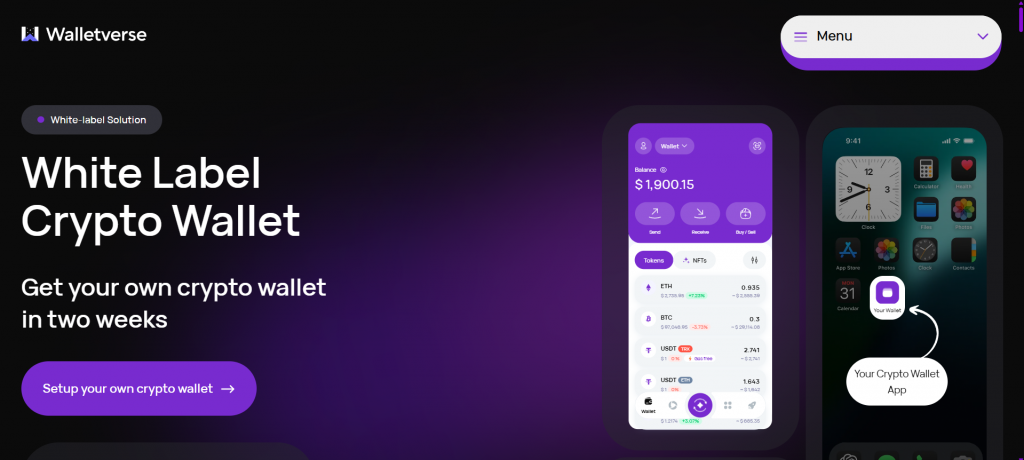
One of the relevant examples of an Android white label app in the fintech sector is Walletverse. Walletverse is a non-custodial crypto wallet solution that allows businesses to launch their own fully branded mobile wallet in a shorter implementation timeline compared with full custom development.
Walletverse is designed for businesses that want a secure and scalable white label digital wallet solution with support for digital assets, mobile wallet access, payment integrations, and Web3 functionality. It can help companies enter the crypto market faster while offering users a branded Android wallet experience.
Walletverse features include:
- Support for over 1,000 cryptocurrencies. The wallet can support Bitcoin, Ethereum, DeFi tokens, and other digital assets;
- Payment processing. Visa, MasterCard, Google Pay, and Apple Pay integrations can support smoother payment flows;
- Security architecture. Walletverse includes CryptoAES encryption, ECDSA authentication, secure seed storage, and security testing practices;
- DeFi and NFT compatibility. Users can access decentralized finance applications and NFT-related functionality;
- AML compliance tools. Anti-Money Laundering functionality can support safer and more compliant transaction flows;
- Fast deployment. Businesses can launch their own branded crypto wallet in a much shorter timeline than building from scratch.
Walletverse represents a practical white label solution for fintech companies that want to provide a secure, user-friendly, and scalable digital wallet without managing the full development process internally.
How to Select the Right White Label Android App Provider
Choosing the right white label provider is important because the provider affects the app’s security, scalability, reliability, and long-term success. For crypto wallet products, the provider should understand both Android app development and digital asset infrastructure.
Key factors to consider include:
- Customization options. The provider should allow the app to be fully branded and modified to match the business identity;
- Security and compliance. The solution should meet high security standards and support relevant compliance requirements for fintech and crypto use cases;
- Scalability. The app should be able to grow with the business, supporting more users, more transactions, and more features over time;
- Support and maintenance. The provider should offer updates, technical support, troubleshooting, and product improvements after launch;
- Integration capabilities. The app should connect with third-party services, payment tools, APIs, exchanges, KYC providers, and analytics systems;
- Wallet infrastructure quality. For a white label cryptocurrency wallet, businesses should also evaluate private key management, transaction logic, supported assets, and blockchain network compatibility.
A reliable provider should help businesses launch faster while still giving them enough control over branding, user experience, and future product growth.
The Future of Android White Label Apps
As technology advances, Android white label apps will continue evolving with stronger security, better personalization, and deeper fintech functionality. In crypto wallet products, future-ready solutions will need to support both everyday transactions and broader Web3 use cases.
Important trends include:
- AI and machine learning. Personalized app experiences, fraud detection, and smarter user insights can improve mobile wallet performance;
- Blockchain integration. Secure and decentralized data management can support digital ownership, crypto transactions, and Web3 services;
- Voice and chatbot assistance. AI-driven virtual assistants can improve customer interaction, onboarding, and support;
- 5G connectivity. Faster performance and real-time app functionality can improve mobile financial experiences;
- Biometric security. Face recognition, fingerprint access, and stronger authentication methods are becoming more important for wallet protection;
- API-driven financial infrastructure. API-based systems can help connect wallets with payments, banking tools, DeFi protocols, and analytics platforms.
For businesses planning white label crypto wallet development, these trends show why mobile wallet infrastructure should be scalable, secure, and ready for future integrations.
How Android White Label Apps Support Business Growth
White label Android apps provide a cost-effective, efficient, and scalable solution for businesses seeking to establish a strong mobile presence without the complexity of full custom app development. In the crypto wallet sector, this model helps companies launch branded wallet products with secure infrastructure, mobile-first access, and digital asset functionality.
For companies planning crypto wallet development, a white label model can shorten the path from product idea to launch. It also allows businesses to focus more on customer acquisition, market positioning, support, and long-term product development rather than building every technical layer from the beginning.
With platforms like Walletverse, companies can enter the digital marketplace faster and offer secure, feature-rich Android wallet applications to their customers. For businesses exploring white label fintech solutions, Walletverse by ilink can serve as a practical example of how ready-made wallet infrastructure can support a faster and more structured launch.
If your business is planning to launch a branded Android crypto wallet, start by defining the required assets, security expectations, compliance needs, target users, payment integrations, and future feature roadmap. A clear strategy will make it easier to choose the right provider and build a wallet experience that supports both users and business growth.