

As crypto adoption spreads globally, more businesses are looking to build and launch their own Web3 products. But developing blockchain infrastructure from the ground up is expensive, time-consuming, and technically demanding. That’s why an increasing number of companies are turning to a smarter alternative: the white label crypto platform.
A white label crypto platform provides all the essential features of a fully functional blockchain product, allowing you to launch it under your own brand, without building it yourself. It’s one of the fastest, most cost-effective ways to enter the Web3 space.
What Is a White Label Crypto Platform?
A white label crypto platform is a pre-built, fully operational crypto solution designed to be rebranded and customized by other businesses. You get all the core functionality, wallets, exchanges, token utilities, DeFi modules, while applying your own logo, design, and business model.
Instead of spending months developing blockchain software, businesses can quickly launch a secure and scalable platform tailored to their needs. These platforms are used by startups, fintech companies, exchanges, NFT marketplaces, DAOs, and Web3 communities.
Types of White Label Crypto Platforms
There are several forms of white label crypto platforms, each serving different use cases:
- White label crypto exchange. Centralized or decentralized trading platforms with built-in liquidity and order books
- White label crypto wallet. Mobile or web-based wallets for sending, storing, and managing assets (custodial or non-custodial)
- White label DeFi dashboard. Ready-made frontends for staking, farming, lending, and borrowing
- White label NFT platform. Marketplaces for minting, buying, and selling NFTs
- White label launchpad. Platforms to run token sales, IDOs, or IEOs with integrated smart contracts
Each of these platforms is customizable and ready for fast deployment.
Key Features of a White Label Crypto Platform
Most modern white label crypto platforms include a robust set of features to meet business and user needs:
- Fully branded design and mobile-first UI;
- Support for multiple cryptocurrencies and blockchain networks;
- Crypto swap, staking, and trading functionalities;
- Integration with external wallets or built-in secure storage;
- Fiat on-ramp/off-ramp via Apple Pay, Google Pay, credit/debit cards, and bank transfers;
- Regulatory tools: KYC/AML, transaction monitoring;
- Admin panel for analytics, user control, and reporting;
- API and SDK access for advanced customizations.
These platforms are built to be secure, scalable, and highly adaptable.
Advantages of a White Label Crypto Platform for Businesses
Choosing a white label approach offers several benefits:
- Faster launch. Get to market in a matter of weeks;
- Lower cost. Avoid heavy development and infrastructure investment;
- Custom branding. Control the look and feel of your platform;
- Security and compliance. Built-in protections and regulatory modules;
- Scalability. Add new chains, tokens, and features as you grow;
- Technical support. Rely on experts for updates, maintenance, and troubleshooting.
This makes it an ideal choice for businesses that want to focus on users and growth, not backend complexity.
Who Should Use a White Label Crypto Platform?
A white label crypto platform is perfect for:
- Startups that want to validate and scale quickly.
- Fintech companies exploring Web3 integration.
- Web3 builders creating token ecosystems or community tools.
- Crypto exchanges expanding into new regions or launching mobile apps.
- NFT platforms want to go live faster with a branded experience.
- DAOs and token projects needing a wallet, utility, or reward infrastructure.
It’s a flexible foundation for nearly any blockchain-based business idea.
Walletverse: A White Label Crypto Platform Example
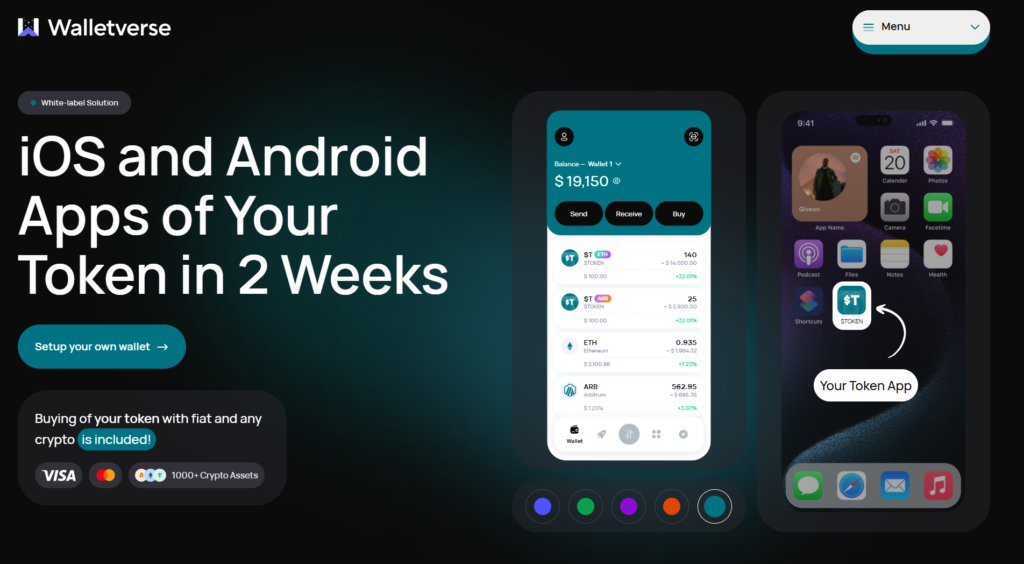
Walletverse is a standout example of a white label crypto platform that helps businesses launch fast, securely, and at scale.
Key features include:
- Support for over 1,000 cryptocurrencies;
- Multi-chain access (Ethereum, BNB Chain, Polygon, etc.);
- Token swaps, DeFi tools, and NFT integrations;
- Non-custodial architecture with biometric protection;
- Apple Pay, Google Pay, and card support;
- Multi-account setup and easy onboarding;
- Deployment in as little as 2 weeks.
Walletverse is used by fintechs, DeFi startups, and NFT platforms around the world as a turnkey solution to enter the crypto market.
How to Launch Your Own White Label Crypto Platform
Launching your own crypto platform using a white label model is straightforward:
- Define your target audience and platform type (wallet, exchange, NFT, DeFi);
- Select a provider that matches your feature and compliance needs;
- Customize your branding (logo, colors, user interface);
- Choose supported networks and integrations;
- Test, deploy, and launch;
- Iterate and grow with performance data and user feedback.
Most platforms offer hands-on support and documentation to guide you through the process.
For businesses aiming to enter the crypto space, a white label crypto platform is the smart, fast-track solution. It delivers everything you need, from blockchain functionality to regulatory compliance, while letting you focus on user acquisition and brand-building.
Whether you’re building the next big DeFi tool, launching a mobile crypto wallet, or creating a tokenized community platform, a white label solution gives you the freedom to innovate without delay.