

As cryptocurrency adoption accelerates, users increasingly expect wallets that are not only secure but also easy to use. Long gone are the days when a complex passphrase and a clunky interface were considered acceptable trade-offs for digital asset safety. Today’s users want seamless access with strong protection—especially on mobile. That’s where biometric authentication comes into play. By integrating biometrics into white label crypto wallets, businesses can offer fast, intuitive access to digital assets without compromising security or decentralization.
The Role of Authentication in Crypto Wallets
Authentication is the gateway to security in any crypto wallet. It ensures that only the rightful owner can access the private keys, approve transactions, and manage digital assets. Traditionally, crypto wallets have relied on PINs, passwords, and seed phrases. However, these methods can be cumbersome for everyday users and are susceptible to phishing, brute-force attacks, or simple human error.
Biometric authentication offers a powerful alternative—providing an extra layer of protection that’s both highly secure and user-friendly.
What Is Biometric Authentication?
Biometric authentication uses unique biological traits—such as fingerprints, facial structure, iris patterns, or voice—to verify a person’s identity. In mobile crypto wallets, this technology is typically powered by native biometric APIs available on iOS and Android platforms.
For example:
- Face ID and Touch ID on Apple devices.
- BiometricPrompt API on Android for face, fingerprint, or iris recognition.
Because these traits are unique to each individual and can’t be easily shared or stolen, biometric authentication offers robust protection with minimal user effort.
Benefits of Biometric Authentication in White Label Wallets
Integrating biometrics into white label crypto wallets delivers several key advantages:
- Enhanced user experience. Users can quickly unlock their wallet or approve transactions without entering passwords or seed phrases each time.
- Stronger security. Biometric traits are extremely difficult to duplicate, reducing the risk of unauthorized access.
- Fraud reduction. By ensuring only verified users can interact with the wallet, biometrics help prevent phishing and social engineering attacks.
- Increased retention. A smoother UX leads to better onboarding and long-term user engagement.
- Cross-device compatibility. Biometric options are widely supported across most modern smartphones and tablets, ensuring accessibility for global users.
How Biometric Security Works Within a White Label Wallet
In a biometric-enabled white label crypto wallet, the user’s biometric data is stored securely within the device’s isolated enclave or hardware security module (HSM)—not on external servers or blockchains. This ensures privacy and compliance with data protection laws.
Biometrics are used to:
- Unlock the wallet app.
- Authorize transactions.
- Authenticate access to features like NFT galleries or DeFi dashboards.
The process is seamless, secure, and complements rather than replaces traditional recovery methods like seed phrases or passcodes.
Implementation Considerations for Developers
To successfully integrate biometrics into a white label wallet, developers must:
- Use OS-level biometric APIs (e.g., Apple’s LocalAuthentication or Android’s BiometricPrompt).
- Implement fallback mechanisms for users without biometric-capable devices.
- Ensure biometric data never leaves the device, complying with privacy regulations like GDPR and CCPA.
- Create a clear and transparent user flow with options to enable, disable, or reset biometric settings.
Done right, biometric security can enhance both privacy and user confidence.
Balancing Security and Convenience: Best Practices
While biometrics simplify access, best practices must be followed to avoid over-reliance or vulnerabilities:
- Allow users to opt-in with full transparency.
- Use biometrics in combination with device risk assessment or behavioral analytics.
- Regularly update the biometric modules and test against spoofing techniques.
- Educate users on the backup methods available in case biometric access fails.
This balance ensures both trust and flexibility in wallet use.
Use Cases and Market Demand
Biometric authentication is especially valuable in the following use cases:
- Crypto traders who need quick, repeated access to their funds.
- NFT collectors managing valuable digital assets securely.
- New users unfamiliar with seed phrases but comfortable with biometric tech.
- Enterprises offering secure, mobile-first wallets to employees or clients.
As mobile usage continues to dominate Web3 interactions, biometric-ready wallets are becoming the norm—not the exception.
Future of Biometrics in Web3 Wallets
Biometric authentication is evolving beyond basic fingerprint or face scans:
- Multi-modal authentication (e.g., combining voice and face).
- Integration with decentralized identity (DID) systems for on-chain reputation.
- On-device AI that learns behavioral biometrics like typing patterns or usage habits.
- Wallet-based Web3 login systems that could replace passwords across dApps and services.
This future positions wallets as secure identity hubs, not just transaction tools.
Walletverse and Biometric Security
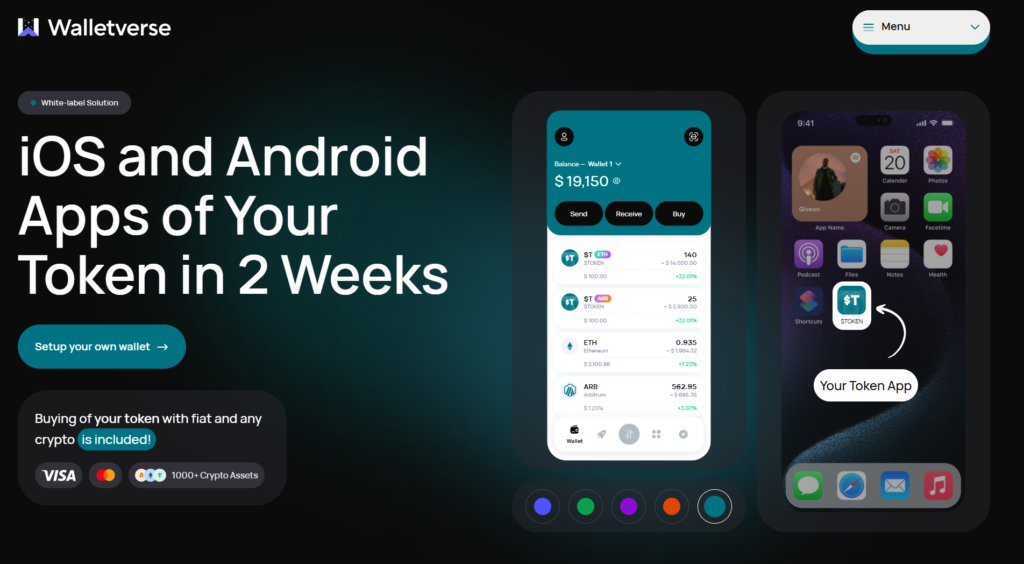
Walletverse is a cutting-edge white label crypto wallet solution that integrates advanced biometric security for both Android and iOS.
Users can unlock wallets and approve transactions with fingerprint or facial recognition, ensuring smooth access without compromising safety.
Walletverse includes:
- Biometric and passcode protection
- CryptoAES and ECDSA encryption
- OWASP SAST compliance
- BIP32, BIP39, and BIP44 protocol support
- Secure entropy storage for seed phrases (128-bit & 256-bit)
- Multi-currency support, DeFi, NFT, and dApp integration
With the ability to launch your branded wallet in just two weeks, Walletverse combines top-tier UX with bulletproof security—making it the ideal choice for companies entering the Web3 space.
In an era where digital convenience and security must go hand-in-hand, biometric authentication offers the best of both worlds. By integrating this technology into white label crypto wallets, businesses can deliver seamless, secure, and modern experiences that users expect.
As biometrics become a standard across mobile devices, wallets that support this functionality will have a clear competitive edge—offering not only protection but also user satisfaction and retention.
Now is the time to upgrade wallet solutions with biometric-ready infrastructure and take full advantage of the next evolution in secure crypto experiences.