

White labeling offers a strategic advantage for businesses that want to enter the crypto wallet market without the heavy investment usually required for full-cycle research, development, security architecture, infrastructure, and long-term product testing.
In the context of wallet infrastructure, this model allows a company to launch a branded product based on technology created by another provider. Instead of building every wallet function from scratch, a business can use a ready-made foundation and adapt it to its own brand, users, compliance needs, and market strategy.
This approach is becoming more relevant as crypto wallet adoption grows. According to Research and Markets (2026), the crypto wallet market is valued at USD 25 billion in 2026 and is projected to reach USD 69.02 billion by 2030, growing at a CAGR of 28.9%. Grand View Research also projects the global crypto wallet market to grow from USD 15.54 billion in 2025 to USD 100.77 billion by 2033, with a CAGR of 26.6% from 2026 to 2033.
This article was prepared by ilink, a software and blockchain technology developer with 14 years of experience in the fintech industry.
Rapid Entry into the White Label Wallet Market
One of the main advantages of a white label crypto wallet is the ability to enter the market faster. Companies can avoid the long and expensive process of developing wallet infrastructure, transaction logic, security layers, integrations, and mobile applications from the ground up.
This is especially valuable in fast-moving Web3 and fintech markets, where launch timing can influence user acquisition, partnerships, and competitive positioning.
A practical launch path often looks like this:
Step 1: Choose a wallet foundation that already supports the required crypto assets, security standards, and user flows.
Step 2: Customize the interface, branding, features, and integrations for the target audience.
Step 3: Launch, test user behavior, and scale the product based on real market demand.
White Label Cost Efficiency
Building a new crypto wallet from zero requires investment in product architecture, blockchain integrations, smart contract interactions, security testing, mobile development, backend infrastructure, and ongoing maintenance.
White labeling reduces these upfront costs because the core product has already been developed and tested. For many businesses, this makes white label crypto wallet development a more practical option than building a fully custom wallet at the first stage.
The saved budget can be redirected to areas that directly support growth:
- User acquisition and market testing;
- Customer support and onboarding;
- Compliance preparation and risk monitoring;
- Product positioning and brand development.
Focus on Core Business
A white label model allows companies to focus on their strongest business areas, such as marketing, sales, customer relationships, partnerships, and product strategy.
Instead of spending months solving low-level infrastructure challenges, teams can concentrate on how the wallet fits into their broader business model. This may include crypto payments, loyalty programs, DeFi access, NFT support, stablecoin transfers, or digital asset management.
This is one reason why a white label wallet solution can be useful for fintech startups, Web3 projects, payment companies, and digital platforms that need wallet functionality but do not want to become infrastructure developers from day one.
White Label Customization and Flexibility
Although the core product is provided by another technology vendor, companies can still customize the wallet experience for their users.
Customization may include visual branding, supported networks, onboarding flows, payment integrations, wallet permissions, analytics, and security settings. A white label crypto wallet app can also be adapted for different business models, including non-custodial wallets, custodial wallet products, crypto payment tools, and Web3 access points.
This flexibility helps businesses respond to user needs faster. If market demand changes, the company can adjust features, integrations, or supported assets without restarting the whole development process.
Scalability for Growing Crypto Products
White labeling gives businesses the ability to expand their wallet product as demand grows. Since the core infrastructure is already in place, companies can add new features or supported assets more efficiently than they could with a fully custom product at an early stage.
Scalability is especially important for wallets because user expectations continue to expand. A modern wallet is expected to support more than basic storage. Ethereum.org describes a wallet as a tool that lets users connect to applications using their Ethereum account, which reflects the broader role wallets now play in Web3 access, identity, and transaction approval.
For businesses, this means wallet infrastructure should be ready for future functionality such as DeFi, NFTs, dApps, swaps, fiat payments, transaction monitoring, and multi-chain support.
Enhanced Brand Loyalty
By offering wallet functionality under their own brand, companies can create a more consistent user experience. Customers do not need to move between separate third-party tools to buy, store, send, exchange, or interact with crypto assets.
This can improve brand loyalty because the wallet becomes part of the company’s wider digital ecosystem. Users are more likely to stay within one product if it is convenient, secure, and aligned with their everyday financial or Web3 needs.
For businesses, a white label digital wallet solution can support stronger user retention by combining wallet access with branded services, support, and product-specific features.
Case Study: Walletverse as a White Label Crypto Wallet Example
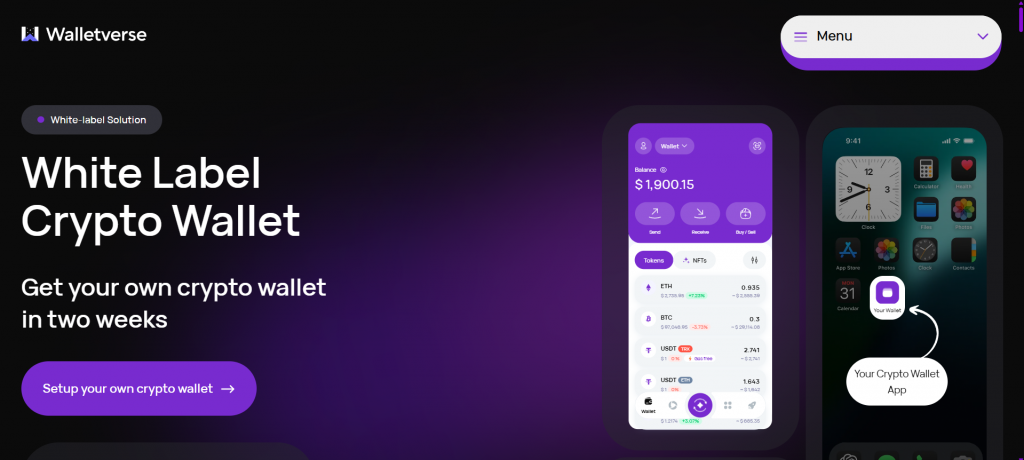
A practical example of a white label solution in the cryptocurrency sector is Walletverse, a non-custodial mobile cryptocurrency wallet. It supports over 1000 different cryptocurrencies and includes advanced features such as biometric protection, password codes, dApp access, DeFi functionality, and NFT support.
Walletverse also offers community support and allows businesses to launch a branded white label solution within just two weeks.
Key features of Walletverse include:
- Payment integrations: Support for Visa, MasterCard, Google Pay, and Apple Pay;
- Security measures: CryptoAES, ECDSA, OWASP SAST, and support for BIP32, BIP39, and BIP44 standards;
- Secure storage: 128-bit and 256-bit entropy for seed phrases, helping protect user credentials and funds;
- AML capabilities: Anti-Money Laundering functionality that helps businesses address regulatory and risk-management requirements;
- Web3 functionality: Support for decentralized applications, DeFi, NFTs, and wallet-based user interactions.
For companies that need more than a basic wallet, a white label product can also connect with related infrastructure such as a white label crypto payment gateway, transaction monitoring tools, and broader white label blockchain solutions.
How White Label Wallets Support Long-Term Growth
White labeling is more than a shortcut to launch. In the crypto wallet sector, it can become a strategic way to reduce development risk, test market demand, control costs, and build a branded product faster.
For startups, it can make wallet launch more realistic without a large engineering team. For established fintech or Web3 companies, it can speed up product expansion and help add wallet functionality to an existing ecosystem.
The main value comes from balancing speed with security, customization, and scalability. A ready-made wallet foundation helps businesses move faster, while branding and feature configuration allow the product to fit a specific audience and use case.
Walletverse by ilink is one practical example of how white label crypto wallet development services can help businesses launch a secure, branded wallet product with Web3, payment, and compliance-related functionality already considered.
If your business is planning to launch a crypto wallet, a white label model can be a practical first step toward entering the market faster while keeping room for customization, growth, and future product expansion.