

As businesses increasingly rely on digital tools to streamline operations and launch new financial services, demand for Software-as-a-Service products continues to grow. In the crypto wallet sector, this trend is especially important because companies need secure, scalable, and user-friendly digital wallet infrastructure without always having the time or resources to build it from scratch.
A white label SaaS solution gives businesses a faster way to offer a fully functional, customizable software product under their own brand. For companies entering fintech, Web3, digital payments, or crypto asset management, this model can reduce technical complexity and make it easier to launch a branded wallet product with existing infrastructure, security features, and backend support.
This article was prepared by ilink, a software and blockchain technology developer with 14 years of experience in the fintech industry.
Understanding White Label SaaS
A white label SaaS platform is a pre-built software solution that businesses can rebrand and resell as their own. The original developer maintains the core infrastructure, while the reseller customizes the branding, pricing, and feature offering.
In the crypto wallet market, this model can be used to launch a white label crypto wallet without developing the full product internally. The provider handles the technical foundation, while the business adapts the wallet to its users, brand identity, business model, compliance needs, and growth strategy.
This approach helps companies expand their product portfolio, strengthen brand presence, and enter new markets faster than building proprietary solutions from zero.
How White Label SaaS Works
White label SaaS follows a clear partnership model. The provider develops and maintains the software, while the business licenses, customizes, and offers it to its own customers.
The process usually works like this:
- Technology provider develops the platform. A provider creates a cloud-based software solution with essential functionality, backend infrastructure, security layers, and maintenance processes;
- Business licenses the software. The company purchases or licenses the platform and defines how it should be customized for its market;
- Branding and features are adapted. The reseller customizes the interface, branding, pricing, features, integrations, and customer-facing experience;
- Product is offered to clients. The reseller launches the solution under its own brand, often adding customer support, onboarding, integrations, or consulting services;
- Provider handles maintenance. The original provider supports hosting, updates, backend infrastructure, security improvements, and core product stability.
This structure allows businesses to focus on sales, customer relationships, service improvements, and market expansion rather than software development and IT maintenance.
Why Companies Choose White Label SaaS
Businesses adopt white label SaaS solutions for several strategic reasons, including faster deployment, cost efficiency, scalability, and new revenue opportunities. In the crypto wallet sector, these advantages are especially valuable because wallet products require secure infrastructure, blockchain integrations, compliance features, and continuous updates.
Key reasons include:
- Accelerated market entry. Launching a SaaS product from scratch can take months or even years. A ready-made white label wallet solution can reduce time to market by giving businesses access to an existing wallet foundation;
- Cost savings on development. Building SaaS software requires developers, designers, security experts, infrastructure, QA, and ongoing maintenance. White label SaaS reduces these upfront costs and provides a more accessible entry point;
- Full brand customization. Although the core software is pre-built, businesses can brand the interface, domain, and user experience to reflect their identity and create a seamless customer experience;
- Scalable business model. White label SaaS platforms often support subscription-based pricing, allowing businesses to grow gradually as demand increases without taking on full backend maintenance;
- No need for deep technical expertise. Since the provider manages hosting, security, and feature updates, businesses can offer a professional software product without hiring a large technical team;
- Revenue generation through SaaS reselling. Reselling a white label SaaS product can create new revenue streams with lower initial investment. Businesses can generate recurring income through subscriptions, service packages, transaction-based features, or premium functionality.
For fintech companies, exchanges, Web3 startups, and digital finance platforms, this model can make wallet-based services easier to launch and monetize.
Industries That Benefit from White Label SaaS
White label SaaS is used across multiple industries, but in the context of crypto wallets, the strongest use cases are connected to fintech, digital payments, blockchain, e-commerce, and financial software. These sectors often need secure digital products that can be deployed faster without compromising reliability.
Industries that can benefit include:
- Fintech and banking. Financial institutions can use white label payment processing, mobile banking, investment platforms, and crypto wallets to expand digital services under their own brand;
- Cryptocurrency and Web3 platforms. Exchanges, DeFi products, NFT marketplaces, and blockchain startups can use wallet infrastructure to support asset storage, transfers, swaps, transactions, and decentralized application access;
- E-commerce and retail. Online businesses can integrate wallet-based payments, crypto checkout options, loyalty systems, and digital asset functionality;
- Marketing and digital platforms. Platforms that work with tokenized rewards, loyalty points, or Web3 customer engagement can use wallet functionality to support user activity;
- Cybersecurity and IT solutions. IT providers can add secure wallet access, identity controls, or encrypted digital asset management to broader technology services;
- Healthcare and regulated services. Businesses in regulated sectors may use secure SaaS infrastructure for user access, payments, data controls, or digital finance features where compliance is required.
For companies building white label fintech solutions, crypto wallet SaaS can become a practical way to connect traditional financial services with digital assets and Web3 functionality.
Key Features of a White Label SaaS Solution
A well-designed SaaS platform should include the features needed to support usability, security, scalability, and business operations. In crypto wallet products, these features become especially important because the platform must protect user assets and support reliable transactions.
Important features include:
- Custom branding. Businesses should be able to modify logos, colors, interface elements, user flows, and customer-facing screens;
- Cloud-based infrastructure. The product should support remote access, uptime, scalability, and reliable performance;
- User management and access controls. Role-based access helps businesses manage different users, administrators, support teams, and compliance workflows;
- API integrations. Compatibility with third-party tools, payment providers, exchanges, KYC services, analytics platforms, and customer support systems helps the wallet fit into a broader business ecosystem;
- Analytics and reporting. Businesses need visibility into user behavior, transaction activity, system performance, and engagement;
- Security and compliance. The platform should support encryption, two-factor authentication, access protection, data privacy, and regulatory requirements such as KYC/AML where relevant;
- Automated billing and subscription management. For SaaS resellers, subscription tools can support recurring payments, pricing tiers, and customer account management.
A strong white label digital wallet solution should combine these SaaS capabilities with secure wallet infrastructure, mobile access, and long-term maintenance.
Walletverse as a Leading Example of White Label SaaS in Fintech
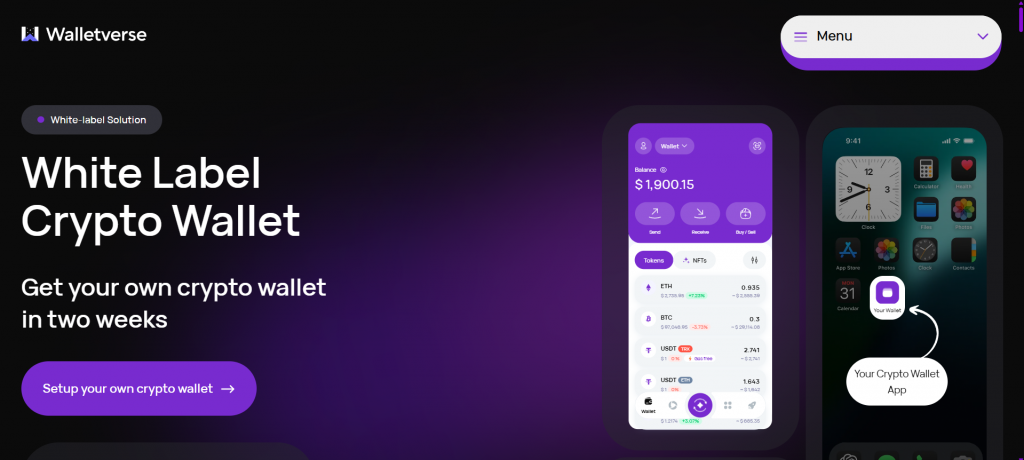
One example of white label SaaS in the fintech space is Walletverse. Walletverse is a non-custodial cryptocurrency wallet platform that allows businesses to launch a fully branded digital wallet with advanced financial capabilities.
As a white label cryptocurrency wallet, Walletverse gives businesses access to ready-made wallet infrastructure while allowing them to adapt the product to their own brand and operational needs. This can help companies enter the digital payments and crypto market with a secure, ready-to-market solution while reducing development complexity.
Key Walletverse features include:
- Support for over 1,000 cryptocurrencies. Businesses can offer users access to Bitcoin, Ethereum, altcoins, and other digital assets;
- Payment integrations. The wallet can support Visa, MasterCard, Google Pay, and Apple Pay integrations for smoother transaction flows;
- Advanced security architecture. Walletverse includes CryptoAES encryption, ECDSA digital signatures, and OWASP SAST security standards;
- DeFi and NFT compatibility. Users can access blockchain-based financial applications, decentralized services, and NFT functionality;
- KYC/AML compliance tools. Compliance functionality can support businesses operating in regulated financial environments;
- Fast deployment. Businesses can launch their own digital wallet within a short implementation timeline compared with full custom development.
Walletverse shows how a wallet-focused SaaS product can help businesses enter the crypto and digital payments space while minimizing development risk and supporting faster market growth.
How to Choose the Right White Label SaaS Provider
Selecting a white label SaaS provider requires careful evaluation because the provider affects product quality, security, scalability, and long-term reliability. For crypto wallets, the provider must also understand blockchain infrastructure, payment integrations, compliance needs, and digital asset security.
Key factors to consider include:
- Customization flexibility. The platform should support full branding modifications, interface adjustments, feature configuration, and market-specific user flows;
- Security and compliance. Businesses should verify data protection, encryption, authentication, access control, and regulatory support, especially for wallet and fintech products;
- Integration capabilities. API support is important for connecting the wallet with third-party tools, payment services, exchanges, KYC providers, analytics systems, and customer support platforms;
- Ongoing technical support. A reliable provider should offer responsive maintenance, updates, troubleshooting, and product improvements after launch;
- Scalability. The software should handle growing user demand, transaction volume, new integrations, and additional functionality without performance issues;
- Pricing model. Businesses should compare subscription fees, licensing structures, revenue-sharing models, setup costs, and customization expenses before making a decision.
A good provider should support the business not only during launch, but also as the product evolves and user expectations change.
The Future of White Label SaaS in Crypto Wallet Products
As digital transformation accelerates, white label SaaS solutions will continue to evolve. In the crypto wallet sector, future-ready SaaS products will likely combine wallet infrastructure with automation, blockchain connectivity, data intelligence, and stronger user security.
Important trends include:
- Artificial intelligence and automation. AI-driven insights, predictive analytics, fraud detection, and workflow automation can improve wallet operations and user protection;
- Blockchain-powered solutions. Blockchain functionality can support transparent transactions, digital asset ownership, smart contract interactions, and decentralized finance use cases;
- Voice and chatbot integrations. AI-driven assistants can improve customer support, onboarding, and user guidance;
- Edge computing and IoT. Faster data processing and connected devices may support new financial and payment use cases;
- Stronger mobile wallet experiences. A white label mobile app can make digital asset access easier for users who manage finance directly from smartphones;
- Secure wallet expansion. For companies planning crypto wallet development, white label SaaS can provide a foundation for adding new assets, payment options, security layers, and Web3 features over time.
These trends show why white label SaaS is becoming relevant not only for general software reselling, but also for fintech companies that want to build scalable crypto wallet products.
How White Label SaaS Supports Faster Product Growth
White label SaaS solutions give businesses a cost-effective, scalable, and time-efficient way to enter digital markets. In crypto wallets and digital finance, this model helps companies leverage pre-built software to expand their offerings, establish a branded product experience, and generate recurring revenue.
With solutions like Walletverse, businesses can deploy a secure and feature-rich fintech platform while bypassing many complexities of custom software development. This makes the model especially useful for companies that want to launch a wallet product faster while still maintaining control over branding, customer relationships, and product positioning.
If your business is planning to launch a branded crypto wallet or digital asset platform, start by defining the required features, supported assets, security expectations, compliance needs, pricing model, and integration requirements. Walletverse by ilink can serve as a practical example of how white label SaaS infrastructure can support faster market entry and a more structured crypto wallet launch.